
Your Team May Be Compensating for the Process
What Workarounds Reveal About Your Business Operations
By Victoria Petersen, MSA-HSA
Founder & Principal Consultant
Medi-Consult Solutions®, LLC
Estimated Reading Time: 10–12 minutes
Introduction
When something isn't working consistently inside a business, the symptoms often show up in the people doing the work first.
Someone keeps a separate spreadsheet.
Someone double-checks a task that technically shouldn't require another review.
Someone has a handwritten reminder beside their computer.
A team member asks for approval even though the decision seems routine.
Another employee has developed their own way of completing a task because the documented process doesn't quite work.
From the outside, these behaviors can look like inconsistency.
Sometimes they are.
But sometimes they are telling you something important about the process itself.
The employee may be compensating for information that is difficult to access, an unclear responsibility, a system limitation, an outdated workflow, or a process that no longer reflects how the organization actually operates.
That's why I don't recommend eliminating a workaround simply because it isn't part of the official process.
First, understand what problem it is solving.
Because the workaround may not be the root problem.
It may be the reason the root problem hasn't become more disruptive.
NOTICE: Look at How the Work Actually Gets Done
A documented process tells you how work is supposed to happen.
Observation tells you how it actually happens.
That difference matters.
As organizations grow and change, employees naturally adapt. They find ways to keep work moving when a system, process, or resource doesn't fully support what they need to accomplish.
Sometimes those adaptations are helpful.
Others create duplicate work, unnecessary approvals, inconsistent handoffs, communication gaps, or additional risk.
The first step isn't deciding whether a workaround is good or bad.
It's noticing that one exists.
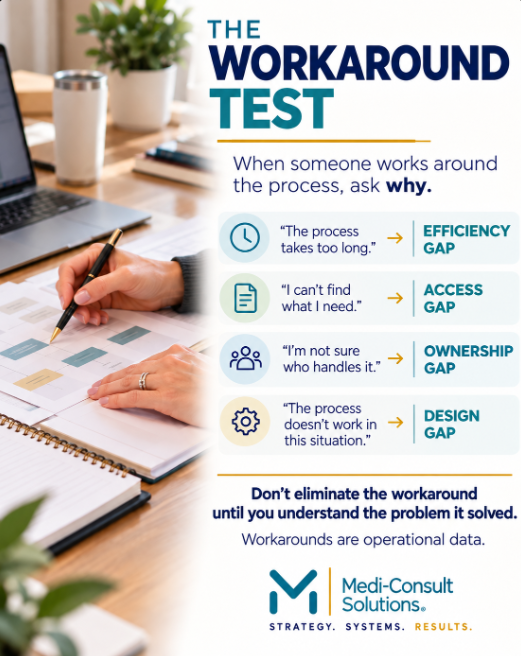
The Workaround Test
When you find someone working around a process, start by asking why.
A few common signals include:
“The process takes too long.”
This may indicate an
efficiency gap.
“I can't find what I need.”
This may indicate an
access gap.
“I'm not sure who handles it.”
This may indicate an
ownership gap.
“The process doesn't work in this situation.”
This may indicate a
design gap.
These statements are useful operational data.
Instead of immediately correcting the behavior, ask what the behavior is revealing about the system around it.
A recurring workaround may be pointing toward a process that needs attention.
UNDERSTAND: What Is the Team Compensating For?
Once a workaround becomes routine, something interesting can happen:
The original problem becomes harder to see.
Imagine that a handoff between two roles isn't reliable.
One employee notices the issue and begins checking every handoff manually.
The additional check works.
Errors decrease.
Work continues.
Eventually, everyone accepts the extra check as part of the process.
The immediate problem appears to be solved—but the underlying handoff was never actually improved.
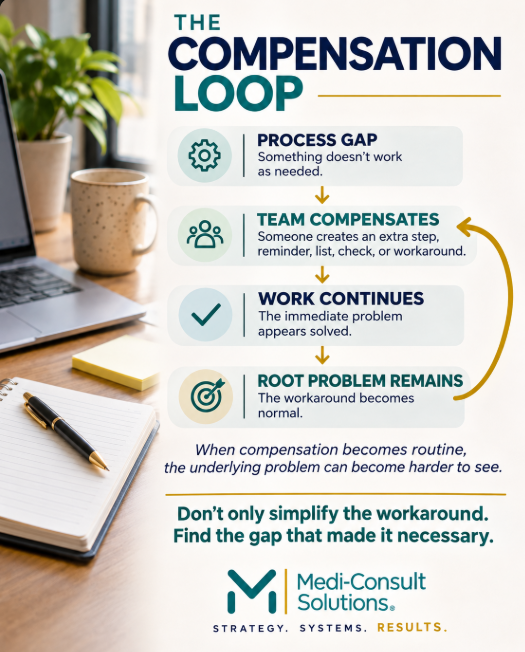
This is what I think of as the Compensation Loop:
Process Gap → Team Compensates → Work Continues → Root Problem Remains
The employee who created the additional step may actually be protecting the organization from the consequences of a process gap.
That doesn't mean the extra step should remain indefinitely.
It means you need to understand its purpose before removing it.
Try asking:
“What would stop working if we took this away tomorrow?”
The answer can be revealing.
You may discover that an unofficial spreadsheet contains information people can't easily access elsewhere.
A manual reminder may exist because the primary system doesn't reliably prompt the next action.
A second review may exist because employees aren't confident in an earlier handoff.
An unnecessary approval may actually be compensating for unclear decision authority.
Once you understand what the team is compensating for, you can address the source rather than repeatedly treating the symptom.
EVALUATE: Does the Process Still Fit the Work?
Not every inefficient process was poorly designed.
Sometimes the organization simply outgrew it.
A workflow may have worked perfectly well when the business had fewer employees, lower volume, different technology, or a narrower range of services.
Then the organization changed.
The process didn't.
Instead, employees gradually adapted around it.
One extra step was added.
Then another.
A spreadsheet filled a gap.
An approval was introduced.
Someone developed a shortcut.
Another employee created a separate tracking system.
Eventually, what was once a straightforward workflow is carrying years of operational adjustments.
That's when I recommend evaluating process fit.
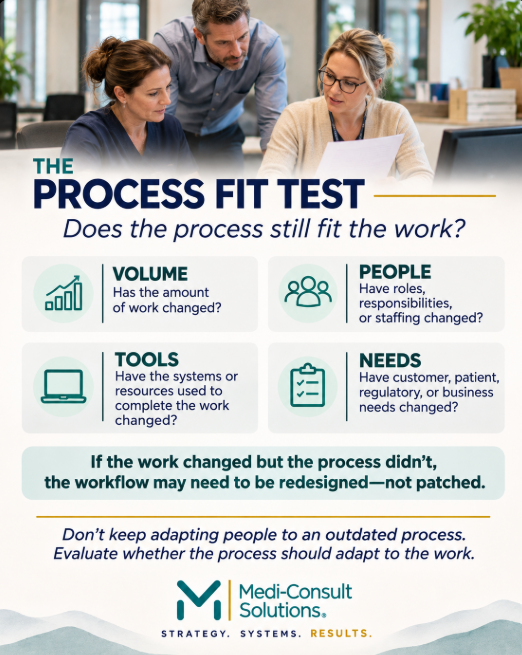
The Process Fit Test
Consider four areas:
VOLUME
Has the amount or frequency of work changed?
PEOPLE
Have staffing, responsibilities, roles, or handoffs changed?
TOOLS
Have the systems, technology, or resources used to complete the work changed?
NEEDS
Have customer, patient, regulatory, or business requirements changed?
If the work has changed substantially but the process hasn't, another workaround may not be the answer.
The workflow itself may need to be reconsidered.
This is an important distinction in process improvement.
Sometimes you need to make an existing process more efficient.
Sometimes you need to stop adapting people to a process that no longer fits the work.
If you're evaluating where workflow friction is occurring, the Workflow Evaluation Toolkit provides a structured way to examine existing processes, identify bottlenecks, and document improvement opportunities.
IMPROVE: Redesign the System, Not Just the Symptom
Once you've identified the workaround, understood what it is compensating for, and evaluated whether the process still fits, you can make a much more informed improvement decision.
That may mean:
- eliminating an unnecessary step
- making information easier to access
- clarifying ownership
- defining decision authority
- improving a handoff
- documenting an informal process
- consolidating duplicate tracking
- changing how a system is used
- standardizing a useful workaround
- redesigning the workflow altogether
The goal isn't to eliminate every adaptation.
Small businesses need flexibility.
The goal is to distinguish between intentional flexibility and operational compensation.
One gives employees appropriate room to respond to the work.
The other requires employees to continually make up for weaknesses in the system.
That difference matters.
Your Team Knows More About the Process Than the Process Map Does
One of the most valuable sources of operational information is often the people closest to the work.
They know where they have to pause.
They know which information is difficult to find.
They know which step creates repeated questions.
They know which process looks simple on paper but requires six additional actions in practice.
And they know which unofficial tools are keeping the work moving.
That doesn't mean every employee-created workaround should become the new standard.
It means those behaviors deserve investigation.
Instead of asking only:
“Why aren't they following the process?”
Try asking:
“What is making the process difficult to follow?”
Instead of:
“Why are we tracking this twice?”
Ask:
“What does the second tracker provide that the first one doesn't?”
Instead of:
“Why does everyone keep asking me?”
Ask:
“What information or authority is missing that keeps bringing this decision back to me?”
Those questions move the conversation away from symptoms and toward operational diagnosis.
Before You Fix the Workflow, Understand It
Process improvement shouldn't begin with a predetermined solution.
It begins with understanding how the organization actually operates.
That's one of the reasons observation and diagnostic work are so important.
A business owner may know exactly how a process was designed.
The team may know exactly how it has evolved.
Both perspectives matter.
When you bring them together, you can begin separating:
what is required
from what has simply become routine,
what is helping
from what is creating friction,
and what needs a small adjustment
from what needs to be redesigned.
Before you remove the extra step, ask why it's there.
Before you correct the workaround, understand what it's compensating for.
And before you ask employees to adapt again, determine whether the process should be adapting to them.
Because sometimes the most important operational improvement isn't asking people to follow the process more closely.
It's building a process that better supports the work they're actually responsible for doing.
Ready to Look More Closely at Your Operations?
If workarounds, repeated questions, duplicate processes, unclear ownership, or leadership bottlenecks have become part of the normal workday, you don't necessarily need to overhaul everything.
You need to identify where the greatest operational friction is occurring—and what is creating it.
The Practice Performance Check-Up™ provides a structured Small Business Operations & Patient Experience Diagnostic to help identify high-impact opportunities and determine where to focus next.
For organizations that already know operational instability is creating day-to-day friction, the Operational Stability Reset™ provides a more focused path toward clarifying workflows, reducing bottlenecks, and building greater consistency.
Or, if you're not sure what your organization needs yet, Schedule a Strategy Call and we can start with what's happening inside your business today.
Systems. Strategy. Results.
© 2026 Medi-Consult Solutions®, LLC. All rights reserved. Practice Performance Framework™, Practice Performance Check-Up™, Operational Stability Reset™, Patient Growth System™, and Team Performance System™ are proprietary methodologies of Medi-Consult Solutions®, LLC.