
How to Reduce Owner Dependency in a Small Business
When Your Business Depends Too Much on You:
The Hidden Cost of Owner Dependency
How stronger systems can reduce unnecessary owner dependency, build organizational capability, and create more capacity to lead.
By Victoria Petersen, MSA-HSA
Founder & Principal Consultant
Medi-Consult Solutions®, LLC
Estimated Reading Time: 10–12 minutes
Introduction
There is a point in many small businesses when being highly involved starts to look a lot like being indispensable.
You answer the questions.
You approve the decisions.
You remember how something was handled six months ago.
You know which customer/patient needs additional follow-up, which employee can handle a particular situation, and which process works differently than the written version suggests.
After all, you built the business. Of course, people rely on you.
Some of that is exactly what leadership should look like.
But when routine work regularly depends on your knowledge, approval, or availability, something different may be happening.
Your organization may have developed owner dependency.
And unlike a major operational failure, owner dependency usually doesn't announce itself.
It develops one small interruption at a time.

Being Needed Isn't the Problem
Let's make an important distinction first.
The goal of operational improvement is not to create a business that no longer needs its owner.
Small organizations naturally rely heavily on their leaders.
In a healthcare practice, for example, clinical judgment and certain regulatory or supervisory responsibilities appropriately remain with qualified leadership. In another service business, the owner may maintain key client relationships, financial authority, strategic decisions, or specialized expertise.
Those responsibilities aren't operational failures.
The more useful question is whether the business also requires the owner for things that shouldn't require the owner.
A routing scheduling decision.
An answer that's been given ten times before.
Finding information.
Explaining an established process.
Approving something that falls well within normal parameters.
Resolving an exception the team could reasonably be equipped to handle.
When those moments repeatedly return to one person, they begin consuming something every small business has in limited supply:
Leadership capacity.
Owner Dependency Rarely Looks Dramatic
Owner dependency often sounds perfectly reasonable.
"Can I ask you one quick question?"
"Can you look at this before I send it?"
"What did we do last time?"
"Are you okay with me handling it this way?"
"Where do we keep that information?"
Any one of those questions may take only a few minutes.
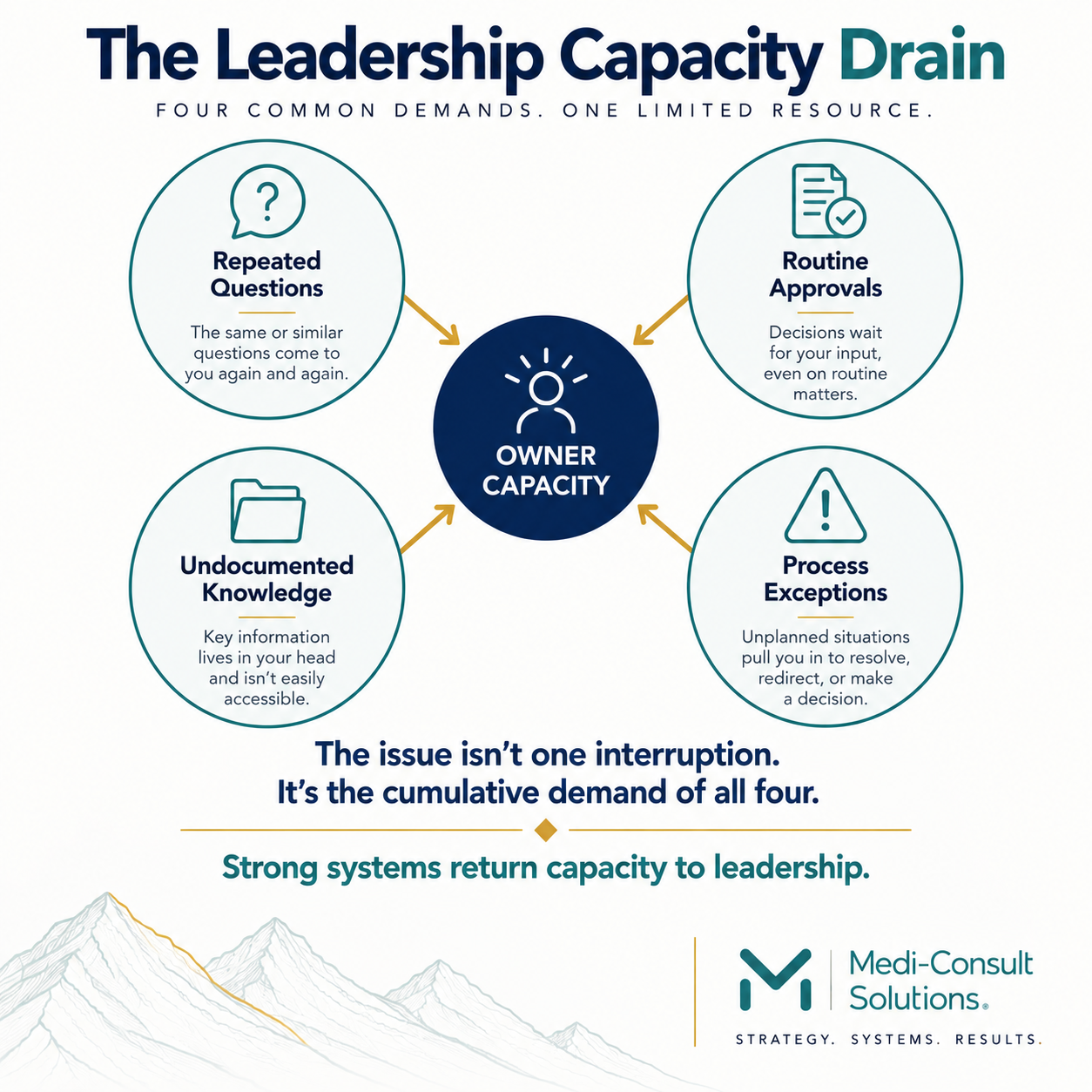
The problem isn't one interruption.
It's the cumulative demand created when routine work repeatedly returns to leadership.
Repeated questions consume a little capacity.
Routine approvals consume a little more.
Information that exists only in the owner's head creates another dependency.
Process exceptions create another interruption.
Individually, they may seem insignificant.
Together, they create what I call the Leadership Capacity Drain.
The owner may still get everything done.
But something else gets displaced.
Strategic planning.
Business development.
Employee development.
Process improvement.
Relationship building.
Or simply enough uninterrupted time to think.
The Owner Dependency Loop
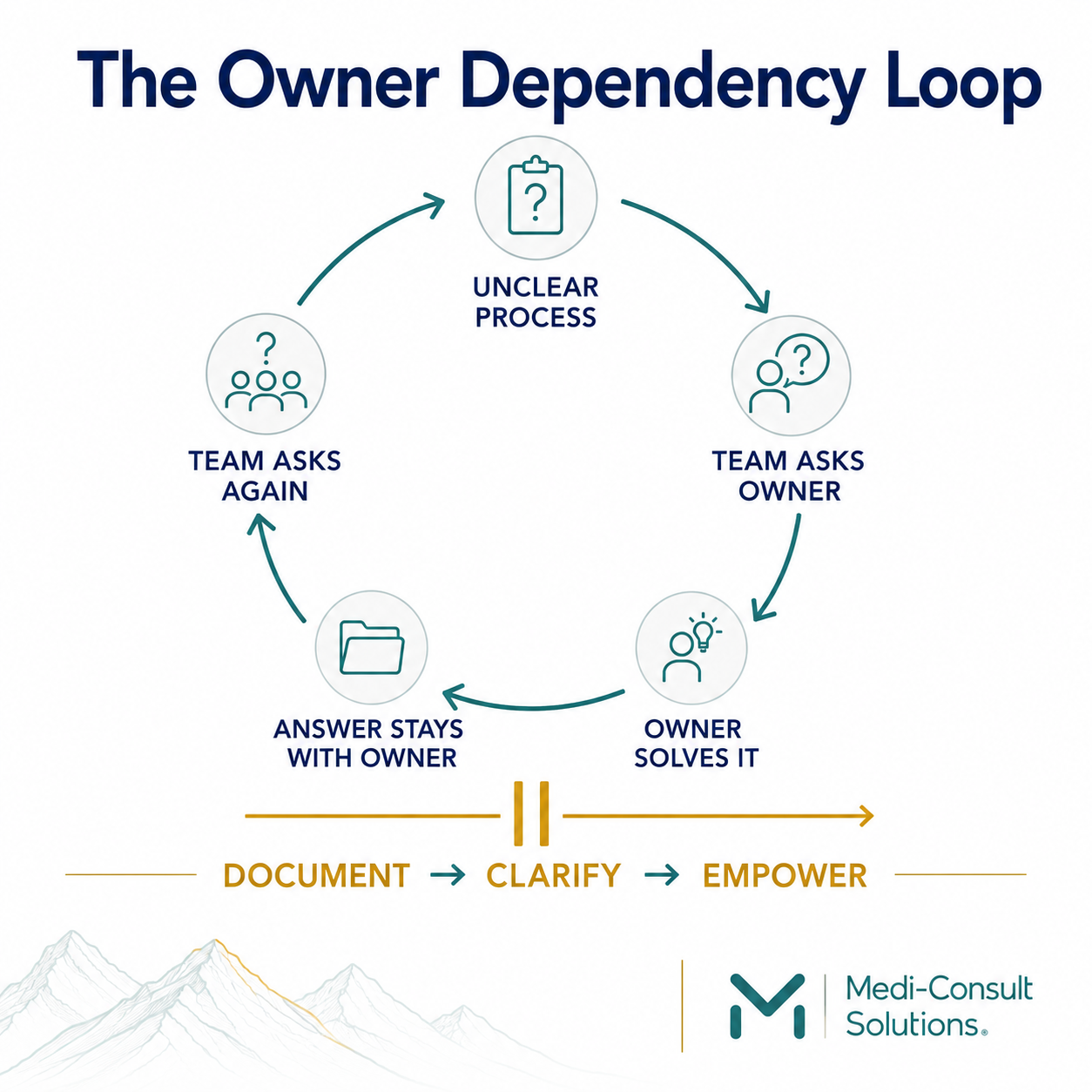
One reason owner dependency persists is that solving the immediate problem often reinforces the underlying pattern.
An employee encounters uncertainty.
They ask the owner.
The owner knows the answer and provides it.
Work continues.
Problem solved.
Except the answer may still exist only with the owner.
So, the next time the situation occurs, the question comes back.
The fastest solution today can unintentionally create tomorrow's dependency.
That doesn't mean leaders should stop answering questions.
It means repeated questions deserve a second question:
Why did the system require someone to ask me this?
Perhaps the process isn't documented.
Perhaps documentation exists but isn't accessible.
Perhaps decision authority isn't clear.
Perhaps training didn't address the exception.
Perhaps roles overlap.
Or perhaps the official process no longer reflects how work actually happens.
That's when an interruption becomes useful operational information.
Instead of seeing the repeated question only as another item requiring an answer, you can begin asking what is creating the question in the first place.
Delegation Alone Doesn't Solve Dependency
A common recommendation given to overwhelmed business owners is simple:
Delegate more.
Sometimes that's exactly what's needed.
But delegation without structure can simply relocate the work temporarily.
You can tell someone:
"You're responsible for this now."
But if the process still lives in your head, if expectations aren't clear, if the employee doesn't know which decisions they can make, or if every exception still requires your approval, the responsibility may have moved while the dependency remains.
That's why the better question isn't simply:
"What can I delegate?"
It's:
"What does someone need in order to own this successfully?"
That shifts the conversation from transferring tasks to transferring capability.
From Owner Knowledge to Organizational Capability
MWhen essential information exists primarily in one person's memory, the organization doesn't truly own that knowledge.
The individual does.
That creates vulnerability, but it also tells us where to begin.
The solution isn't documenting every thought you've ever had or producing a 200-page operations manual nobody will use.
Start with information that repeatedly affects the work.
What questions do people ask again and again?
Which decisions consistently return to you?
Which process changes depending on who's working?
Where do employees rely primarily on verbal instruction?
What would someone struggle to locate if you were unavailable tomorrow?
Those patterns identify where individual knowledge should begin becoming organizational capability.
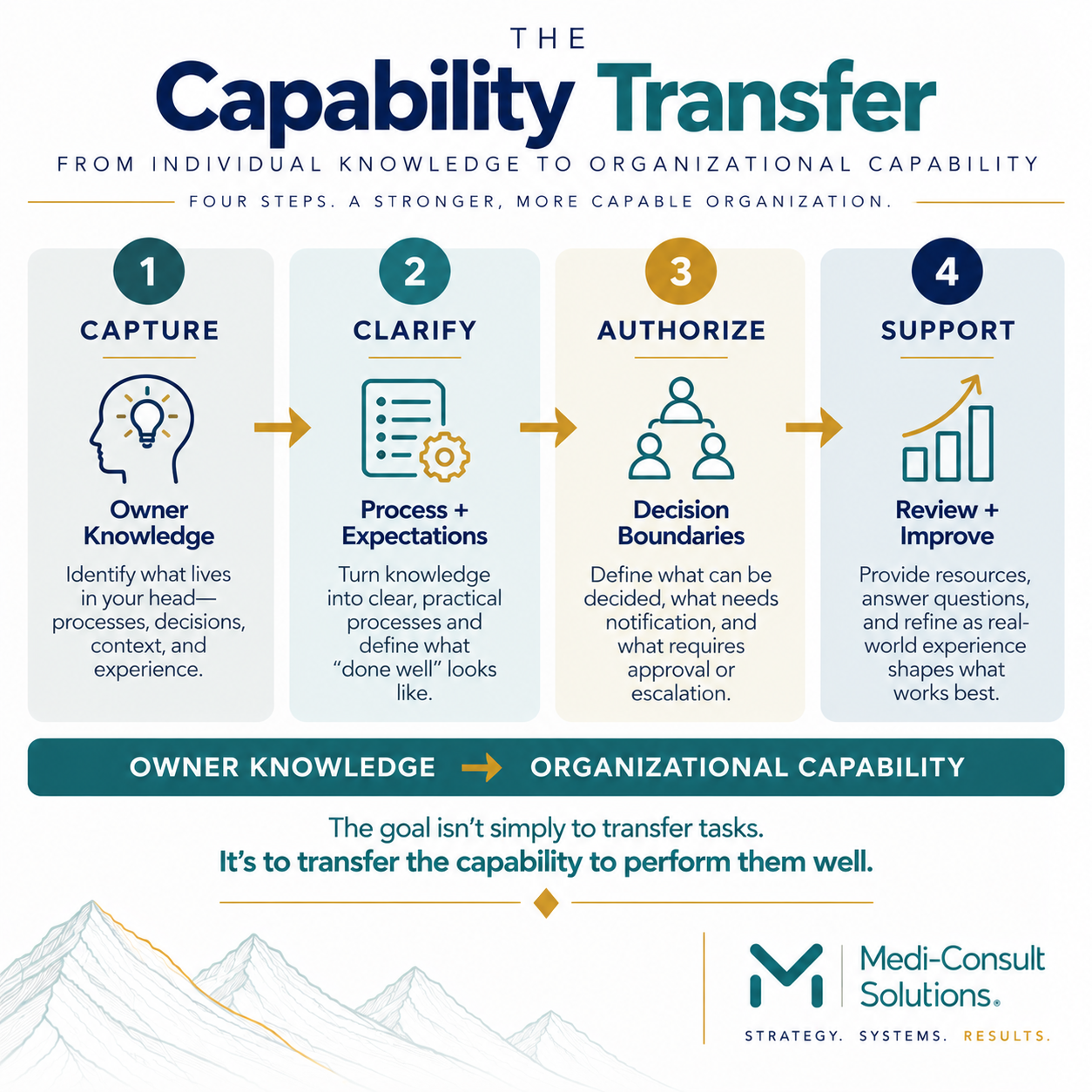
I think of that transition in four stages:
Capture. Clarify. Authorize. Support.
First, capture the knowledge that currently lives with an individual.
Next, clarify the process and what successful performance looks like.
Then, define appropriate decision boundaries so the person understands what they can handle independently and what still requires escalation.
Finally, support the process as real-world experience identifies what works, what doesn't, and what needs to improve.
Decision Boundaries Matter as Much as Documentation
A procedure can tell someone how to perform a task.
It doesn't necessarily tell them what they're allowed to decide.
That's why even organizations with written processes can experience constant approval bottlenecks.
An employee may understand exactly how the process works and still ask:
"Am I allowed to do this?"
Clear decision boundaries help answer questions such as:
- What can I handle independently?
- What can I decide and communicate afterward?
- What requires approval beforehand?
- What situations should always be escalated?
- Who becomes the decisionmaker when the usual person is unavailable?
This isn't about putting oversight where it actually adds value.
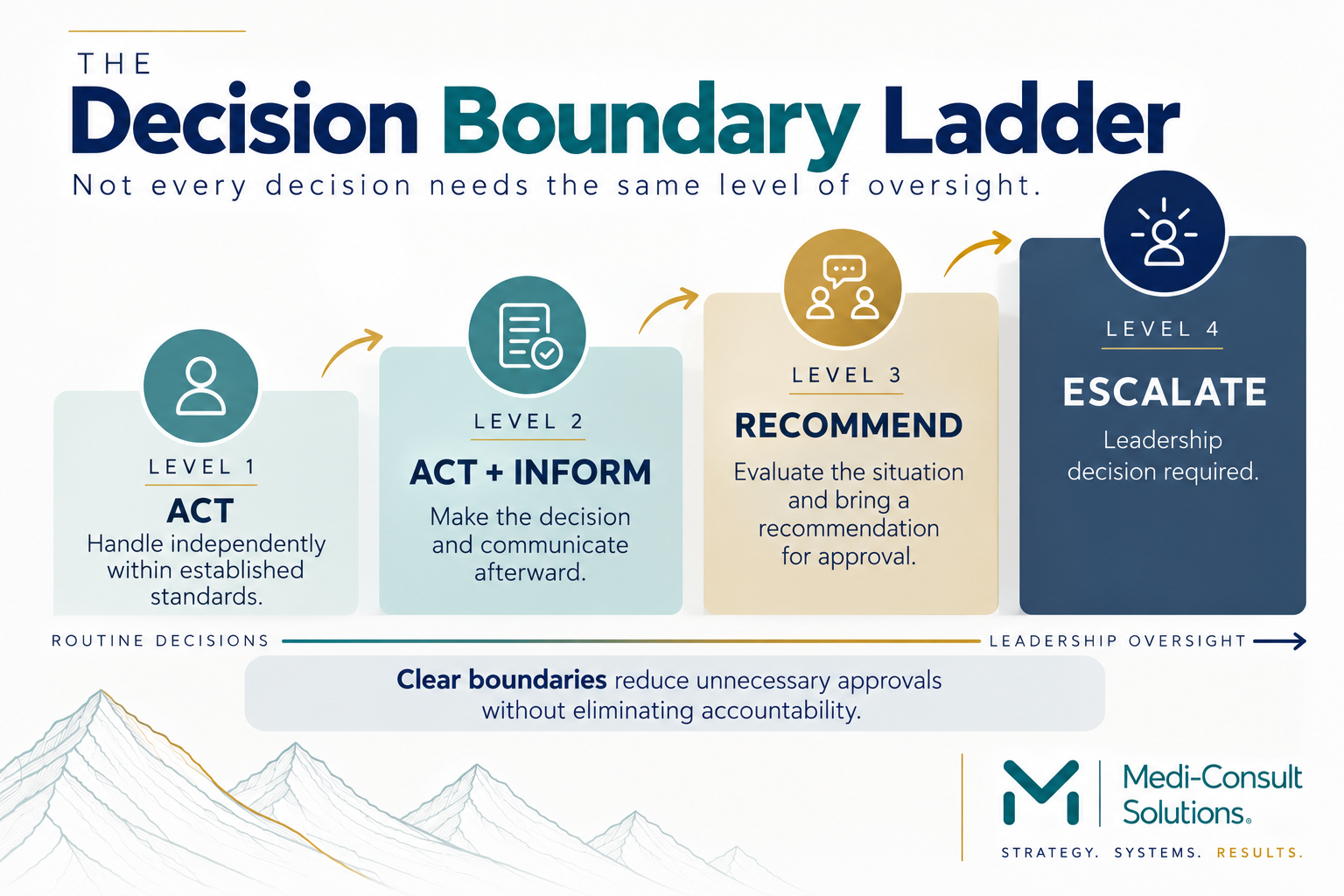
A useful way to think about decisions is by the degree of authority they require:
- Act: The employee handles the decision independently within established standards.
- Act + Inform: The employee makes the decision and communicates afterward.
- Recommend: The employee evaluates the situation and brings a recommendation to the appropriate decisionmaker.
- Escalate: The situation genuinely requires leadership involvement.
Not every organization will use these exact levels, and not every responsibility should carry the same degree of autonomy.
That's the point.
Decision authority should be intentional, not assumed.
System-Supported Doesn't Mean Rigid
There's another misconception worth addressing.
Systems aren't meant to eliminate judgment.
Good systems tell people where judgement belongs.
They create enough consistency around routine work that employees can devote more attention to situations that genuinely require thought, judgment, expertise, or creativity.
That's particularly important in healthcare practices and service businesses, where no procedure can anticipate every human interaction.
The objective isn't:
"Follow the process no matter what."
It's
"Understand the standard. Know your authority. Recognize the exception. Know what happens next."
That's a very different kind of organization.
It's not rigid.
It's capable.
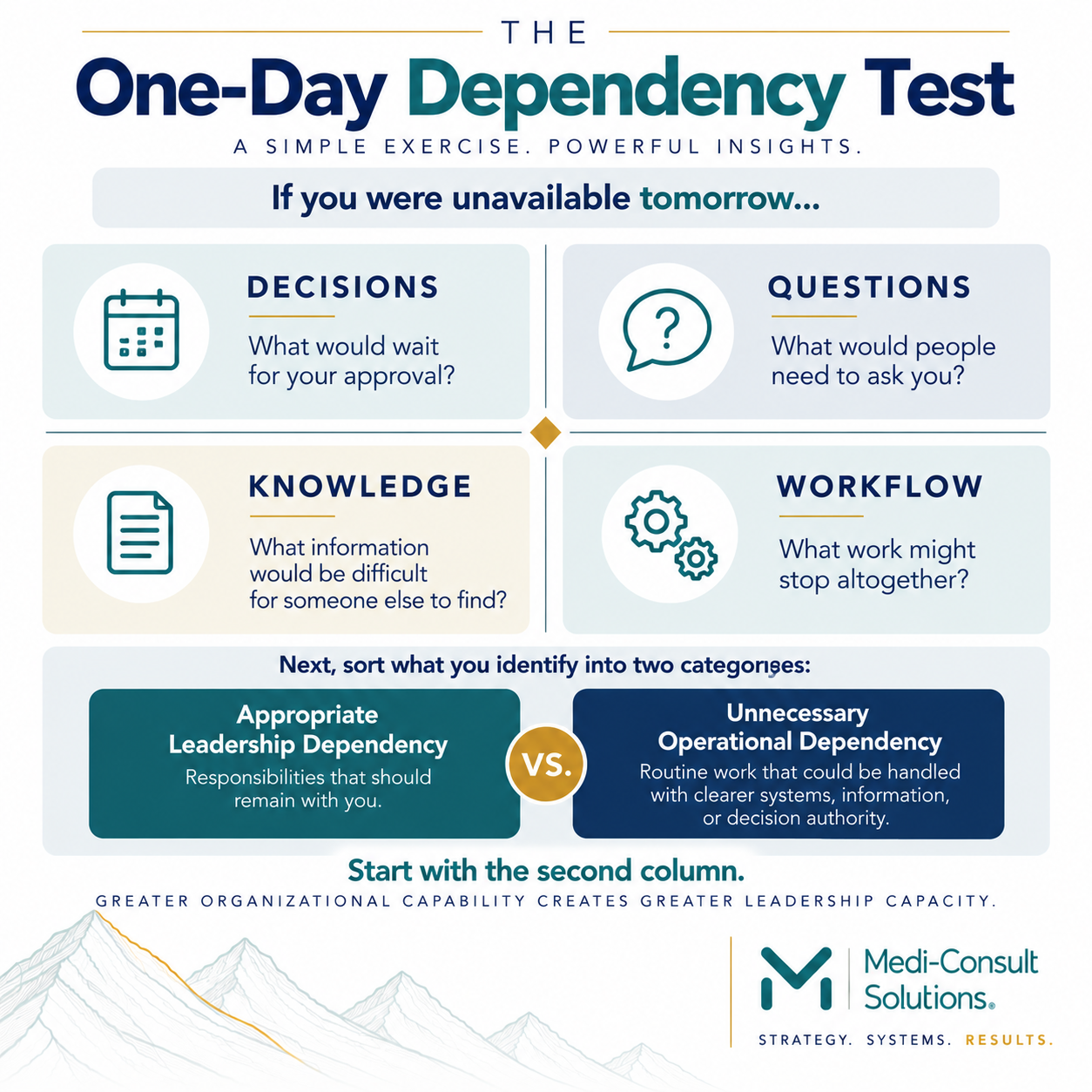
What Would Happen If You Were Unavailable Tomorrow?
You don't need an elaborate operational assessment to begin identifying owner dependency.
Start with one day.
Imagine you're unexpectedly unavailable tomorrow.
Not six months.
Not even a week.
One full workday.
Then ask four questions.
- Decisions - What would wait for your approval?
- Questions - What would employees need to ask you?
- Knowledge - What information would be difficult for someone else to find?
- Workflow - What work might stop altogether?
Write down your answers without immediately trying to solve them.
Then separate what you've identified into two categories:
Appropriate Leadership Dependency
and
Unnecessary Operational Dependency
Some responsibilities absolutely should remain dependent on leadership.
Keep them there.
The second category deserves more attention.
If routine work stops because information isn't accessible, authority isn's clear, expectations aren't documented, or employees don't know how to proceed, you've identified an opportunity to strengthen the system.
Don't Try to Systemize Everything at Once
Once owners recognize dependency, it's tempting to start documenting everything.
That's rarely where I recommend beginning.
Start where dependency creates the most friction.
Look for:
- questions that repeatedly return to the same person;
- routine decisions waiting unnecessarily for approval;
- information employees regularly struggle to locate;
- inconsistent processes;
- recurring exceptions;
- responsibilities with unclear ownership; and
- work that stops when one person isn't available.
Then ask:
Which of these creates the greatest ripple effect across the organization?
That might be the place to begin.
One clear checklist may have more immediate value than a comprehensive manual.
One defined approval threshold may eliminate dozens of interruptions.
One standardized handoff may improve both employee and customer experience.
One documented answer may prevent the same question from being asked another 15 times.
Operational improvement doesn't have to start big.
It has to start intentionally.
Stronger Systems Don't Replace Leadership
Reducing owner dependency isn't about becoming less important to your business.
It's about becoming more important for the right reasons.
Your organization should benefit from your leadership.
Your judgement.
Your experience.
Your relationships.
Your strategic direction.
It shouldn't require your constant intervention simply to complete routine work.
That distinction is where better systems begin.
And it's one of the areas I consider when evaluating how an organization operates through the Practice Performance Check-Up™ and when addressing operational friction through the Operational Stability Reset™.
Both are part of the broader Practice Performance Framework™, which helps organizations identify what needs attention, stabilize operations, support growth, and strengthen team performance.
Because ultimately:
The goal of operational improvement isn't owner independence.
It's organizational capability.
And greater organizational capability creates something every owner needs:
More capacity to lead.
The goal of operational improvement isn't owner independence.
It's organizational capability.
Greater organizational capability creates greater leadership capacity.
Where Does Your Organization Depend on You Most?
Sometimes the challenge isn't recognizing that something feels inefficient.
It's determining why it's happening and what should change first.
The Practice Performance Check-Up™ is a Small Business Operations & Patient Experience Diagnostic designed to evaluate how your organization operates today and identify opportunities that may have the greatest impact.
If owner dependency, repeated interruptions, unclear processes, inconsistent workflows, or leadership bottlenecks sound familiar, we can start by looking at what's happening beneath the symptoms.
Let's identify what's creating the friction, and the right next step for your organization.
© 2026 Medi-Consult Solutions®, LLC. All rights reserved. Practice Performance Framework™, Practice Performance Check-Up™, Operational Stability Reset™, Patient Growth System™, and Team Performance System™ are proprietary methodologies of Medi-Consult Solutions®, LLC.